
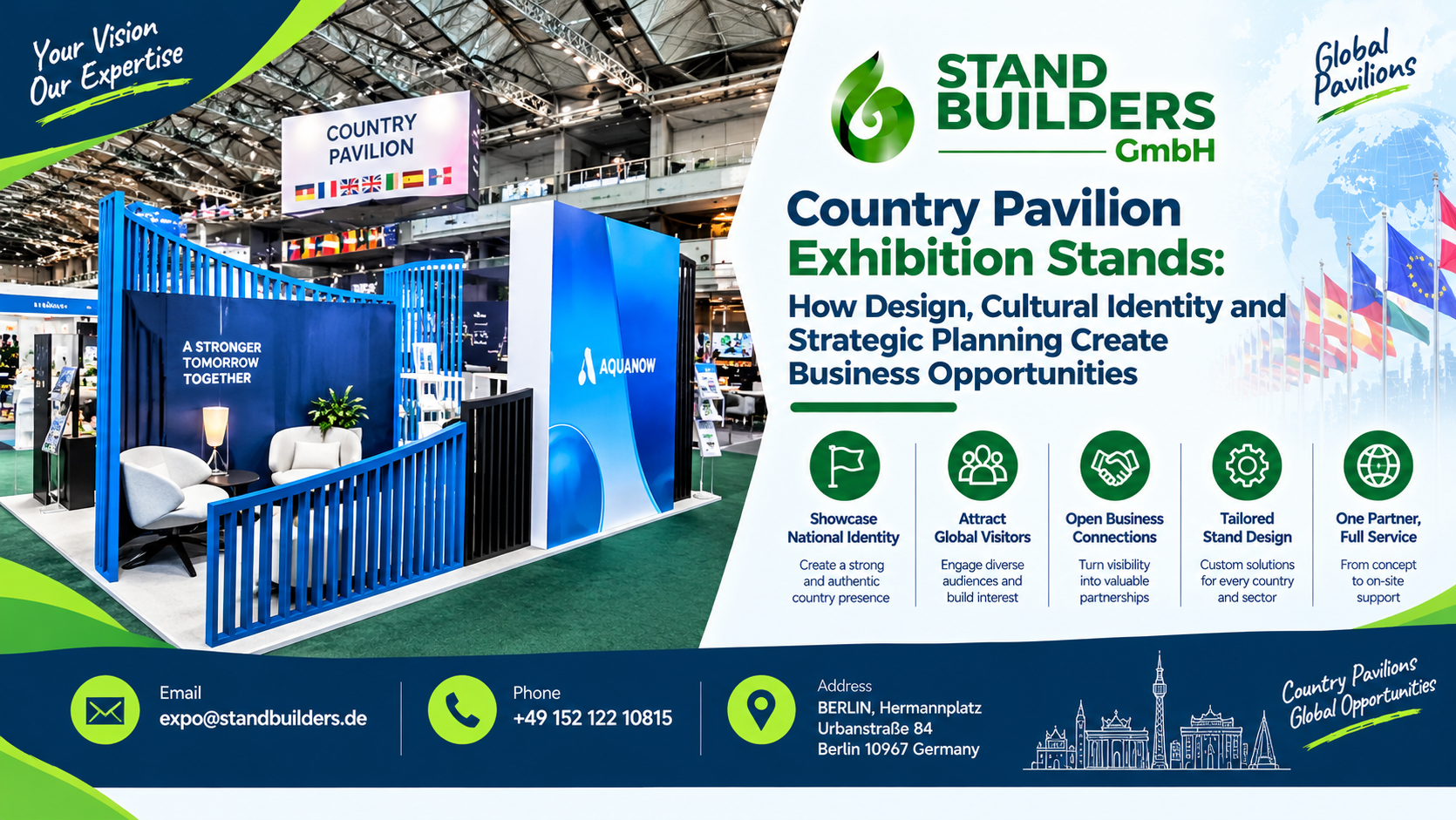
Country Pavilion Exhibition Stands: How Design, Cultural Identity and Strategic Planning Create Business Opportunities
International trade fairs provide countries with an opportunity to present their industries, innovations, and business capabilities to a global audience. Instead of participating through completely separate exhibition spaces, companies from the same country can come together within a coordinated pavilion that represents their shared national identity. Developing such a space requires careful planning, consistent branding, and practical construction arrangements. For organisations searching for the best Stand builder in Germany, understanding the specialised requirements of country pavilion exhibitions can help them choose a suitable construction partner. Stand Builders GmbH, based in Berlin, provides exhibition stand design and construction services for international exhibitors participating in trade fairs across Germany and Europe.
Understanding the Purpose of a Country Pavilion at International Exhibitions
A country pavilion is a specially designed exhibition area where multiple businesses, organisations, or institutions from the same country participate under a common national presentation. Rather than creating unrelated booths, the pavilion connects individual exhibition spaces through shared design elements, signage, and architectural features.
These exhibition structures are commonly used by trade promotion organisations, industry associations, export development agencies, and groups of businesses entering international markets. Their purpose is not simply to display products but also to communicate the strengths of a country’s industries and encourage commercial relationships.
For example, a country participating in an international manufacturing exhibition may bring together companies specialising in machinery, industrial components, automation, and engineering services. Each company needs its own presentation area, but the entire pavilion should still feel like one coordinated exhibition environment.
This combination of collective visibility and individual branding is what makes country pavilion design different from conventional exhibition booth construction.
One Pavilion, Several Brands: Finding the Right Design Balance
The main challenge in country pavilion planning is creating a consistent visual identity without making every participating company look identical. A national pavilion must communicate unity while allowing individual exhibitors to present their products and services independently.
Stand Builders GmbH addresses this requirement through country pavilion exhibition stand designs that combine cultural representation with practical business presentation. Its dedicated country pavilion exhibition stands service focuses on coordinated booth structures, branding, graphics, and interactive features suited to group participation.
Creating a Recognisable National Presentation
National colours, cultural references, and shared architectural elements can help visitors recognise a country pavilion from a distance. However, effective cultural representation does not require excessive decoration. Modern design features can communicate national identity while maintaining a professional appearance suitable for international business events.
The most useful approach is to establish a consistent design language across the pavilion. Entrance features, overhead signage, common walkways, and shared information counters can reinforce the collective identity.
Preserving the Identity of Individual Exhibitors
Each participating company still needs sufficient visibility. Its logo, product information, contact details, and display materials should remain easy to identify.
Individual booth areas may have different furniture arrangements, display equipment, or demonstration requirements. A coordinated pavilion design should accommodate these differences without disrupting the overall presentation.
This is particularly important when participating businesses operate in different industries or offer products requiring different amounts of space.
Why Country Pavilions Need More Than Attractive Architecture
A successful national pavilion must function as a working business environment. Visitors should be able to identify participating companies, move between exhibition areas, and find suitable places for conversations.
The internal layout therefore deserves as much attention as the exterior appearance.
Wide and clearly defined circulation routes help visitors explore the pavilion without confusion. Information desks can direct people towards relevant exhibitors, while shared meeting areas may support discussions that require additional privacy.
For pavilions containing several small businesses, the positioning of individual booths is especially important. A poorly organised layout may cause some exhibitors to receive less visibility than others.
Designers should also consider accessibility, lighting, electrical connections, storage, and the technical requirements of the exhibition venue. These practical details influence how comfortably exhibitors can operate throughout the event.
How Cultural Elements Can Support Commercial Communication
Country pavilions often represent more than individual products. They may also communicate a country’s manufacturing expertise, creativity, technological development, or export potential.
Cultural elements can help create a distinctive atmosphere, but they should complement the business message rather than distract from it.
For instance, a pavilion promoting sustainable industries might combine national branding with information about innovation, materials, and environmental initiatives. A pavilion representing design-oriented businesses may use contemporary architectural features and carefully selected graphics.
Digital screens and interactive presentations can provide additional information about participating companies, industries, and investment opportunities. When used thoughtfully, these features help visitors understand the relationship between the pavilion’s national identity and the businesses exhibiting within it.
Stand Builders GmbH describes the integration of graphics, interactive elements, and modern presentation technology as part of its approach to country pavilion construction.
The Four Exhibition Stand Services Offered by Stand Builders GmbH
Although country pavilions are a specialised exhibition format, Stand Builders GmbH also provides other stand solutions for businesses with different presentation requirements. Understanding these four services helps exhibitors determine which structure is most appropriate for their objectives.
1. Country Pavilion Exhibition Stands
Country pavilion stands are designed for multiple exhibitors participating under a shared national or organisational identity. They combine individual company areas with coordinated branding, cultural representation, and common exhibition facilities.
These structures are particularly relevant to trade associations, national delegations, and organisations promoting international business cooperation.
2. Custom Exhibition Stands
Custom exhibition stands are developed around the requirements of an individual business. Their layout, appearance, materials, and display features can be adapted to specific products and branding objectives.
They are suitable for companies that need distinctive presentation environments, specialised demonstration areas, or a design closely aligned with their corporate identity.
3. Modular Exhibition Stands
Modular stands use adaptable components that can be arranged for different exhibition spaces. Their flexibility makes them useful for businesses participating in multiple trade fairs throughout the year.
When components are suitable for reuse, exhibitors can adjust layouts and update graphics without necessarily producing a completely new structure for every event.
4. Double-Decker Exhibition Stands
Double-decker stands provide an additional level above the main exhibition floor. The upper area can be used for meetings, hospitality, or other approved functions, while the lower level remains available for displays and visitor interaction.
These structures require detailed technical planning and must comply with the exhibition organiser’s structural and safety regulations.
Together, these four stand formats allow Stand Builders GmbH to support individual businesses as well as larger groups participating in international exhibitions.
What Makes Country Pavilion Projects More Complex?
Unlike a conventional booth designed for one company, a country pavilion often involves several decision-makers. The organising association may establish the overall budget and visual identity, while participating businesses have individual branding and display requirements.
This creates a greater need for communication and clearly defined responsibilities.
Design approval can become complicated when several exhibitors request changes independently. A practical solution is to establish a central project contact who coordinates information, confirms requirements, and communicates approved decisions to the stand contractor.
Space allocation also needs careful consideration. Participating companies may require different booth sizes depending on their products, staff numbers, and presentation activities.
Technical requirements must be collected early, particularly when exhibitors need large display equipment, digital installations, or specialised electrical connections.
The earlier these details are agreed upon, the easier it becomes to develop a coordinated design and realistic construction schedule.
From Pavilion Concept to Exhibition-Ready Construction
Turning a country pavilion concept into a completed exhibition structure involves several connected stages. Stand Builders GmbH provides project support covering design, production, logistics, installation, and dismantling.
The process begins with understanding the organiser’s objectives, the number of participating exhibitors, the available exhibition area, and the desired national presentation.
A 3D design helps visualise the pavilion’s overall appearance and the relationship between individual booths and shared facilities. This allows organisers to review important features before manufacturing begins.
Once the design is approved, the production stage involves preparing structural elements, graphics, counters, and other required components. Stand Builders GmbH operates in-house production facilities, allowing design and manufacturing activities to be coordinated within its project process.
After production, components are packaged and transported to the exhibition venue. Installation teams assemble the pavilion according to the approved design and applicable venue requirements.
On-site project coordination supports the final preparation stages. Following the exhibition, the structure is dismantled, and suitable reusable components may be stored for future use.
Planning a Country Pavilion That Works for Every Participant
The quality of a pavilion should not be judged only by its appearance. Its success also depends on whether participating companies can use the space effectively.
Organisers should begin by identifying the pavilion’s main purpose. Some national delegations prioritise export promotion, while others focus on investment opportunities, tourism, technology, or industry development.
The next consideration is how the participating companies will be represented. Clear signage, appropriate booth dimensions, and convenient visitor access help ensure that individual businesses remain visible within the collective design.
Shared facilities should also be planned according to actual requirements. A meeting room may be valuable for business negotiations, while an information counter can help visitors locate exhibitors.
Budget planning should account for construction, graphics, transportation, installation, technical services, and dismantling. It is also important to clarify which expenses are included in the contractor’s quotation and which remain the responsibility of the organiser or participating companies.
The Value of Country Pavilions Beyond a Single Trade Fair
Country pavilion exhibitions can support longer-term international business development. They bring companies into a shared environment where visitors can discover several businesses from one market during a single visit.
This arrangement may encourage networking between exhibitors as well as conversations with potential buyers, distributors, and industry representatives.
After the event, organisers can evaluate visitor engagement, business meetings, enquiries, and feedback from participating companies. These observations provide useful information for improving future pavilion layouts and exhibition strategies.
Reusable structural components may also support participation in subsequent events, provided they remain suitable for the new venue and design requirements.
Conclusion
Country pavilion exhibition stands serve a distinctive purpose at international trade fairs. They bring multiple companies together through shared national branding while providing individual spaces for product presentations, meetings, and commercial interaction.
Their effectiveness depends on balancing cultural representation with practical exhibition design, clear visitor movement, technical planning, and coordinated project management.
Stand Builders GmbH provides country pavilion exhibition stand design and construction alongside custom, modular, and double-decker stand solutions. With services covering 3D design, in-house manufacturing, logistics, installation, dismantling, and storage, the company supports different stages of exhibition preparation across Germany and Europe.
For trade promotion organisations, industry associations, and international exhibitors, thoughtful country pavilion planning can create a professional collective presence while giving each participating business the opportunity to communicate its own strengths and develop valuable commercial connections.