
What Happens During a Full-Body Skin Cancer Check?
Booking a first skin check can feel a little vague. You know that somebody will examine your moles, but you may be wondering how much clothing needs to come off, whether every mark will be photographed and what happens if the doctor finds something unusual.
A full appointment at a Sydney skin cancer clinic usually begins with a conversation rather than an examination. The doctor will ask about previous skin cancers, family history, sun exposure and any spots that have changed or caught your attention. This information helps them understand your personal risk and gives you the chance to point out concerns that may not be obvious during the check.
Preparing for the appointment
Wear clothing that is simple to remove and avoid fake tan before the appointment because it can make the skin harder to examine. Minimal makeup is helpful, and nail polish should be removed where possible so the doctor can see the nails properly.
It’s also worth thinking about your skin before you arrive. If a mole has recently changed colour, started itching or behaved differently, make a note of it. A photograph on your phone showing how it looked several months ago may also be useful. Nobody expects you to know whether a mark is dangerous. Your job is simply to mention anything you have noticed.
The full-body examination
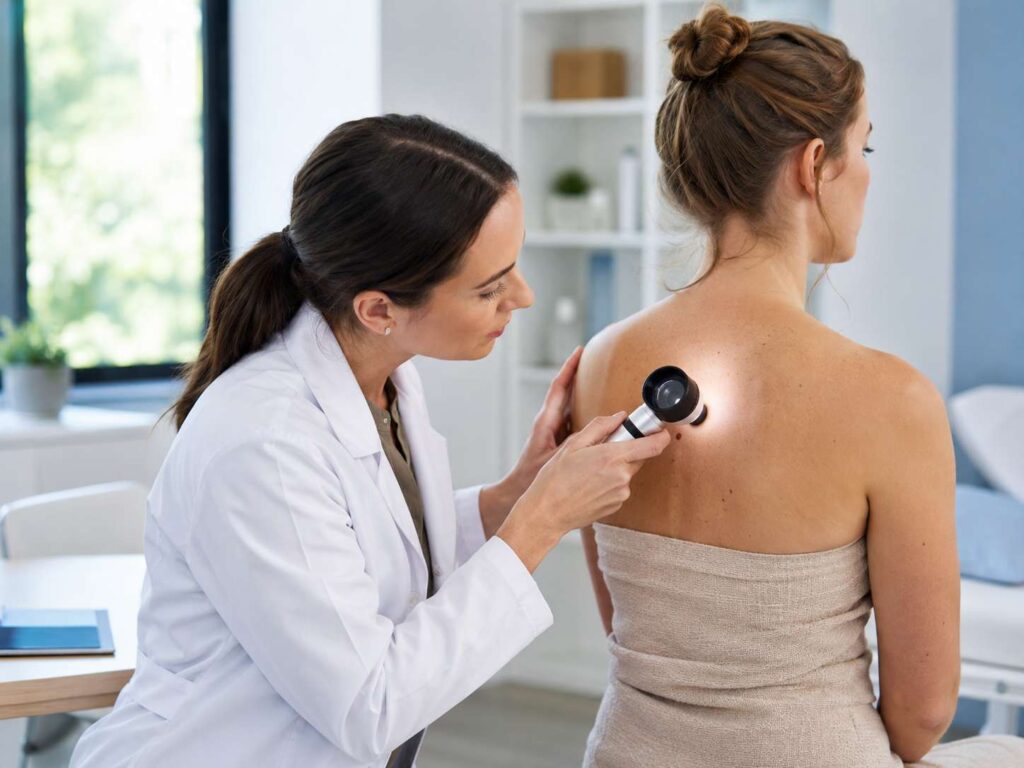
You will usually be asked to undress to your underwear, with privacy and appropriate draping provided. The doctor then examines the skin systematically rather than looking only at the obvious sun-exposed areas. This may include the scalp, back, palms, soles of the feet and around the nails.
Areas covered by underwear aren’t always examined routinely, so speak up if you have a spot there that concerns you. You remain in control of the examination and can ask questions or decline any part of it.
The doctor may use a dermatoscope, which is a handheld instrument with light and magnification. It allows colours and structures beneath the surface of a mole to be seen much more clearly. The device is placed against or just above the skin and the examination itself shouldn’t hurt.
How photography and mole mapping are used
Some clinics use clinical photography, digital mole mapping or AI-assisted dermoscopy to record particular spots. These tools don’t replace the doctor’s assessment. They provide additional images and measurements that may help the doctor examine a lesion or compare it with photographs taken at a later appointment.
Not every mole needs to be photographed. A doctor may record spots that have particular features or lesions that would benefit from monitoring over time. This is especially helpful for people with many moles because a future comparison may reveal a change that is difficult to remember by sight alone.
What happens if a spot looks suspicious
A suspicious spot doesn’t automatically mean skin cancer. Depending on its appearance, the doctor may recommend monitoring it, photographing it or taking a biopsy. A biopsy involves removing part or all of the lesion under local anaesthetic and sending the tissue to a pathology laboratory for examination.
Some clinics can perform a biopsy, cryotherapy or another minor procedure during the same visit when clinically suitable and when enough time is available. In other cases, a separate appointment will be arranged. The doctor should explain why the procedure is recommended, what it involves and when the result is likely to be available.
A full check at Skin Cancer Gregory Hills generally takes around 30 to 40 minutes, although it may take longer when somebody has many lesions or several concerns to discuss. Before leaving, ask when your next check should be. There is no single timetable that suits everybody, so the recommended interval should reflect your skin type, history, sun exposure and anything found during the appointment.