
What to Expect with SEO for 2027
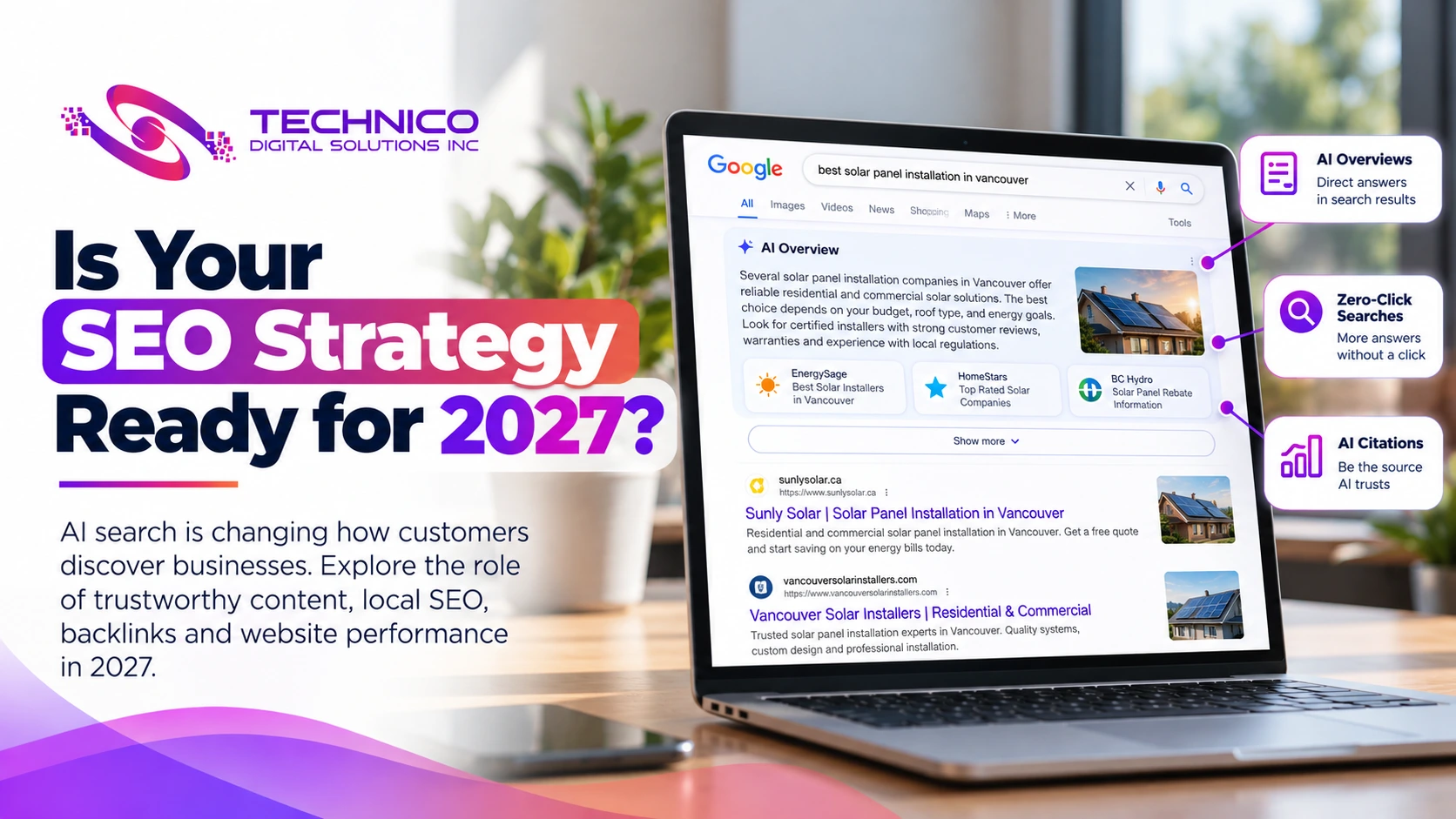
SEO for 2027 will focus less on traditional rankings alone and more on being the business that search engines and AI systems can confidently understand, trust, recommend, and cite. Google Search is increasingly answering questions directly through AI-generated results, while users are also turning to generative platforms to research businesses, products, and services.
That does not mean traditional SEO is going away. Rankings, organic traffic, technical performance, local search, and backlinks still matter. The difference is that a business can no longer measure its search visibility by asking only, “What position do we rank for?”
The better question for 2027 is: “Does our business appear when someone asks an AI or search engine for the answer?”
| 68% of U.S. Google searches now end without a click
This means the person gets what they need without ever opening a website. The number went up from about 60% just two years earlier. Follow that line into 2027, and it stops looking like an edge case. |
Google made the scale of this pretty clear at its I/O event in 2026, confirming that AI Mode had already passed a billion monthly users in its first year, with AI Overviews reaching somewhere around 2.5 billion people a month. That’s not a side feature tucked into search anymore. For a huge number of people, that is the search experience now.
The Big Shift From Ten Blue Links to One Honest Answer
A zero-click search happens when someone types a question, gets a summarized answer sitting right at the top of the page, and never scrolls further. Ask “how often should a driveway be sealed in coastal BC,” and instead of ten links to sort through, you might just get a short, direct answer, generated on the spot, pulling from a handful of sources the AI trusts enough to summarize.
That’s convenient for the person searching. It’s a different game for the business that used to live at position one. Because now, ranking first in the old sense doesn’t guarantee you’re the one being read out loud, or summarized, or credited. Being the source an AI system chooses to cite has become its own separate strategy.
New Vocabulary: AEO and GEO
You’ll start hearing these two acronyms a lot more heading into 2027, and neither is as complicated as it sounds.
| AEO — Answer Engine Optimization | GEO — Generative Engine Optimization |
| Writing and structuring content so an AI system can lift a clean, confident, correctly-attributed answer straight out of it — instead of the AI having to guess, paraphrase awkwardly, or credit a competitor instead. | The broader practice of making sure a brand, its products, and its expertise are understood and represented accurately across generative AI tools like AI Overviews, ChatGPT, and Perplexity — not just inside classic Google rankings. |
In practice, this comes down to something almost old-fashioned: writing the way people ask questions out loud, then answering plainly before going deeper. Compare the two approaches below.
| keyword-shaped heading
Vancouver Driveway Sealing Services |
question-shaped heading
How much does it cost to seal a driveway in Vancouver? |
How does this actually look on a page?
| Q: How often should a driveway be resealed in coastal BC?
A: Most asphalt driveways in coastal British Columbia need resealing every two to three years. The higher rainfall and repeated freeze-thaw cycles wear down sealant faster than in drier inland climates, so homes closer to the coast tend to sit at the shorter end of that range. |
Notice the pattern: A direct answer first, in plain language, then a sentence or two of the actual reasoning behind it. That structure is exactly what an answer engine is built to lift and quote.
Only 38% of AI-cited pages also rank in the top 10
A February 2026 study from Ahrefs, looking at roughly four million AI Overview citations across close to 863,000 keyword searches, found that share down sharply from 76% just eight months earlier. Ranking well and getting cited by an AI summary are starting to look like two separate games, and a business can win one without the other.
Trust Becomes a Ranking Factor You Can Ultimately See
E-E-A-T is the term Google’s own quality guidelines use for how content and websites get judged: Experience, Expertise, Authoritativeness, and Trustworthiness. It’s not new for 2027, but it’s about to matter more than it ever has, because AI systems lean on exactly the same signals when deciding which sources to trust enough to quote.
That means the small, human details start pulling real weight.
- A real name attached to a piece of content, rather than “Admin.”
- A short bio explaining why that person is qualified to write about, say, foundation repair or immigration law.
- Genuine photos of the actual team and actual work, not stock images.
- Consistent, verifiable information about who the business is and where it operates.
None of this is flashy. All of it is exactly what tells a machine, and a person, that there’s someone real and credible standing behind the page.
Speed and Feel Still Matter
Google’s Core Web Vitals have been part of ranking since 2021, and by 2027 the bar they set has quietly moved higher. Three numbers do the talking:
| LCP (Largest Contentful Paint) | How long the main content takes to eventually appear. |
| INP (Interaction to Next Paint) | How responsive the page feels when someone taps or clicks something. |
| CLS (Cumulative Layout Shift) | Whether elements jump around while the page loads. |
What counted as “good” performance a few years ago now reads as merely average. And since so much browsing happens on mobile, over varying connection speeds, a site that feels noticeably worse on a phone than on a desktop is actively signalling that it hasn’t kept pace.
A new scoreboard: measuring citations, not just clicks
If fewer searches end in a click, then click-through rate alone stops telling the whole story. Businesses heading into 2027 need a wider scoreboard: how often the brand gets mentioned or cited inside AI-generated answers, how consistently its name shows up across AI platforms, alongside the traditional metrics that still matter, like rankings, direct traffic, and phone calls.
AI-driven Search Share Could Top 28% by 2027
Semrush research places AI search at roughly 12-15% of global search share in early 2026, projecting growth to exceed 28% within the year. A separate report from Adobe and Incisiv puts it more simply: by 2027, something like one in five search queries may run through an LLM rather than a traditional search engine. None of that means traditional SEO disappears.
SEO for 2027 Isn’t the Death of SEO. So, What Should a Business Do?
It comes down to a handful of concrete, repeatable habits.
✓ Lead with a direct answer in plain language, then explain the reasoning after.
✓ Full hours, real photos, accurate categories, and a name-address-phone number that matches every other listing online exactly.
✓ Business details, authorship, and article information, kept current as the business changes.
✓ Fix real performance problems.
✓ Real names, real credentials, real photos of real work. The human signals both people and AI systems are trained to look for.
None of this makes SEO more complicated. If anything, it’s becoming more honest. Put in the real expertise, the real clarity, and the real trust signals, and both people and machines tend to notice. For small businesses across British Columbia trying to keep pace without a full in-house team, Technico Digital Solutions lays that groundwork, one page, one schema block, one Google Business Profile at a time.
Frequently Asked Questions
Will long-form content still be important for SEO in 2027?
Yes, but length itself will not make content rank or get cited. A 1,000-word page that answers a customer’s question clearly can be more useful than a 3,000-word article padded with repetition. Long-form content will remain valuable when a topic genuinely requires detailed explanations, examples, comparisons, evidence, or multiple related questions.
Will updating old content matter more than publishing new content?
For many websites, yes. Updating an existing page can be more valuable than publishing another page when the existing content has outdated facts, statistics, services, prices, regulations, examples, or recommendations. A 2027 SEO strategy should include a process for identifying pages that have become inaccurate or less useful over time.
Will backlinks still matter for SEO in 2027?
Yes. Backlinks are likely to remain useful as signals of authority and reputation, particularly when they come from relevant, credible websites. The emphasis should be on earning meaningful references rather than accumulating large numbers of low-quality links through directories, guest-post networks, or other manipulative tactics.